Precision Equipment Transport Cases
For equipment too heavy, too large or too delicate for a carry case: transport systems engineered around the route — loading, lifting, vibration and unloading included.
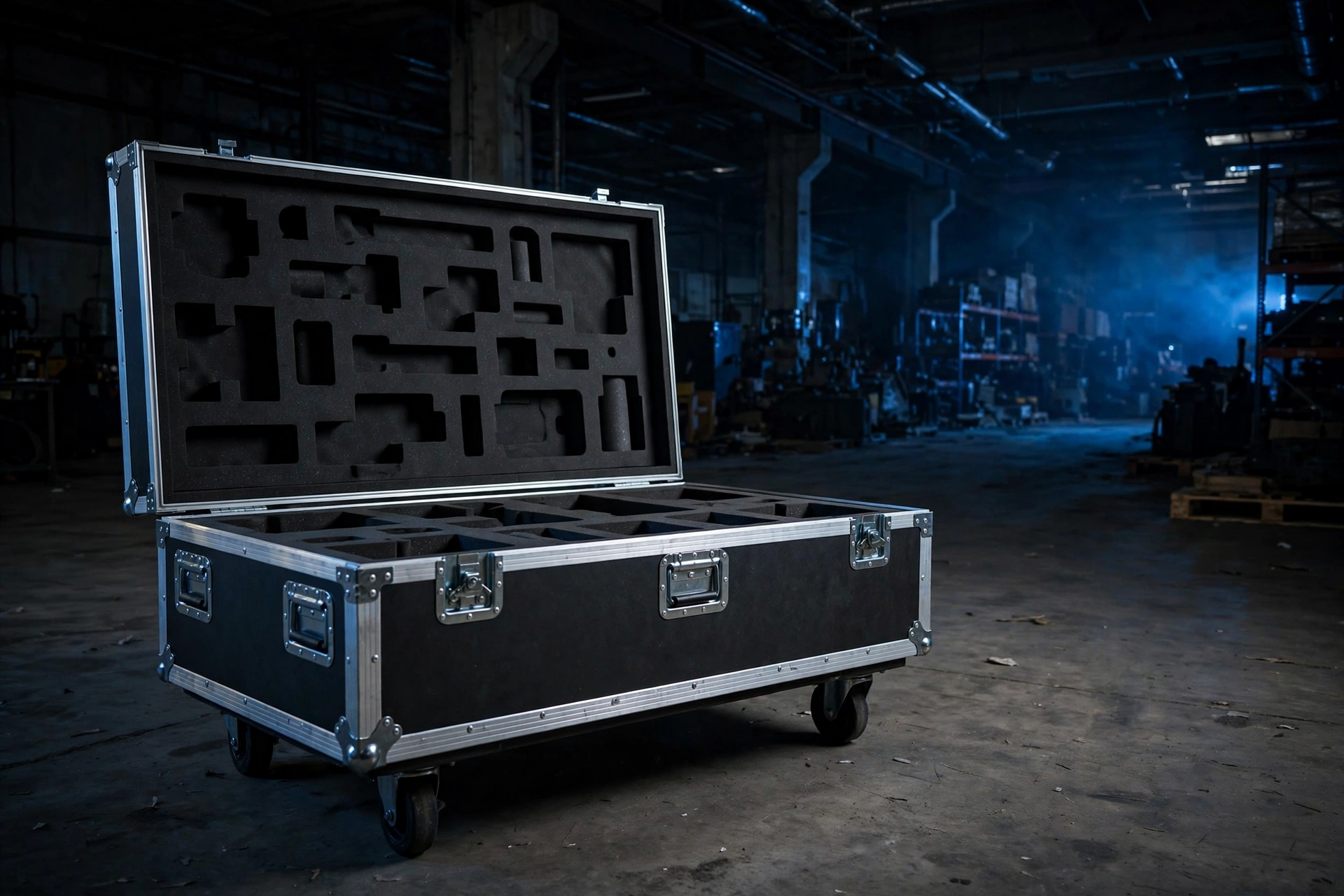 Concept visualisation
Flight-case construction
Laminated plywood panels with aluminium extrusion edges, steel ball corners, recessed butterfly latches and handles — the proven construction for equipment that tours, demos and ships repeatedly. Panels, hardware and interior are sized to the load, not picked from a size chart.
Shock isolation, designed in
Fragile payloads ride on engineered foam cradles or, for heavier and more sensitive loads, a suspended inner frame. Isolation is tuned to payload weight and fragility — too stiff transmits the shock, too soft bottoms out. Accessories, cables and calibration gear get their own fitted compartments.
Built for how it will actually move
Castors & mobility
Swivel and braked castor sets rated for the gross weight, with corner placement that keeps the case stable in transit.
Ramps & loading
Split lids, ramp doors and lift-off sections so heavy equipment loads without being manhandled over a case wall.
Forklift & skid bases
Pallet-style bases and fork channels for warehouse handling, plus tie-down points for vehicle and air-freight restraint.
Route protection
Moisture-barrier liners, desiccant provision and lid seals matched to sea freight, air freight or road transport.
Inputs we design from
| Payload | Equipment dimensions, weight, centre of gravity and fragility notes (or the manual) |
|---|---|
| Route | Road / air / sea; number of handling events; who loads and unloads |
| Construction | Laminated ply flight case, welded/skidded timber system, or large-format moulded case |
| Isolation | Foam cradle system or suspended frame, tuned to payload weight and fragility class |
| Accessories | Fitted compartments for cables, tools, calibration kits and documentation |
| Marking | Stencilled handling marks, this-way-up and fragile graphics, asset labels |
Typical applications
Demonstration and exhibition equipment that tours repeatedly; heavy precision instruments moving between laboratories and plants; calibration and test systems shipped to customer sites; and machinery components that need ramp loading and forklift handling rather than manual lifting. See Industries Served for the full picture.
Frequently asked questions
When do I need a transport case instead of a protective case?
When the equipment is too heavy, too large or too delicate for a carry case, or moves repeatedly between sites. Transport cases use flight-case construction — laminated plywood panels, aluminium extrusion edges and steel hardware — sized to the load rather than picked from a size chart.
How is shock isolation designed?
The payload rides on engineered foam cradles or, for heavier and more sensitive loads, a suspended inner frame. Isolation is tuned to payload weight and fragility: too stiff transmits the shock, too soft bottoms out.
Can the case include castors, ramps or a forklift base?
Yes. Options include swivel and braked castor sets rated for the gross weight, split lids and ramp doors for loading, pallet-style skid bases with fork channels, and tie-down points for vehicle and air-freight restraint.
What do you need from me to design a transport case?
Equipment dimensions, weight, centre of gravity and fragility notes (or the equipment manual), plus the route: road, air or sea, the number of handling events, and who loads and unloads.
How does a transport case project run?
Every project runs through our six-step process — brief and drawings, engineering proposal, prototype, approval, production, then QC and dispatch. For drawing-based RFQs, the engineering proposal and itemised quotation are prepared after an engineering review of the drawings.
Describe the equipment and the journey.
Dimensions, weight and route are enough for a first construction proposal and quotation.