Returnable Industrial Packaging
When parts travel the same route again and again, single-use packaging is a recurring cost and a waste stream. Returnable systems pay for themselves in trips — if they are engineered for the loop they will live in.
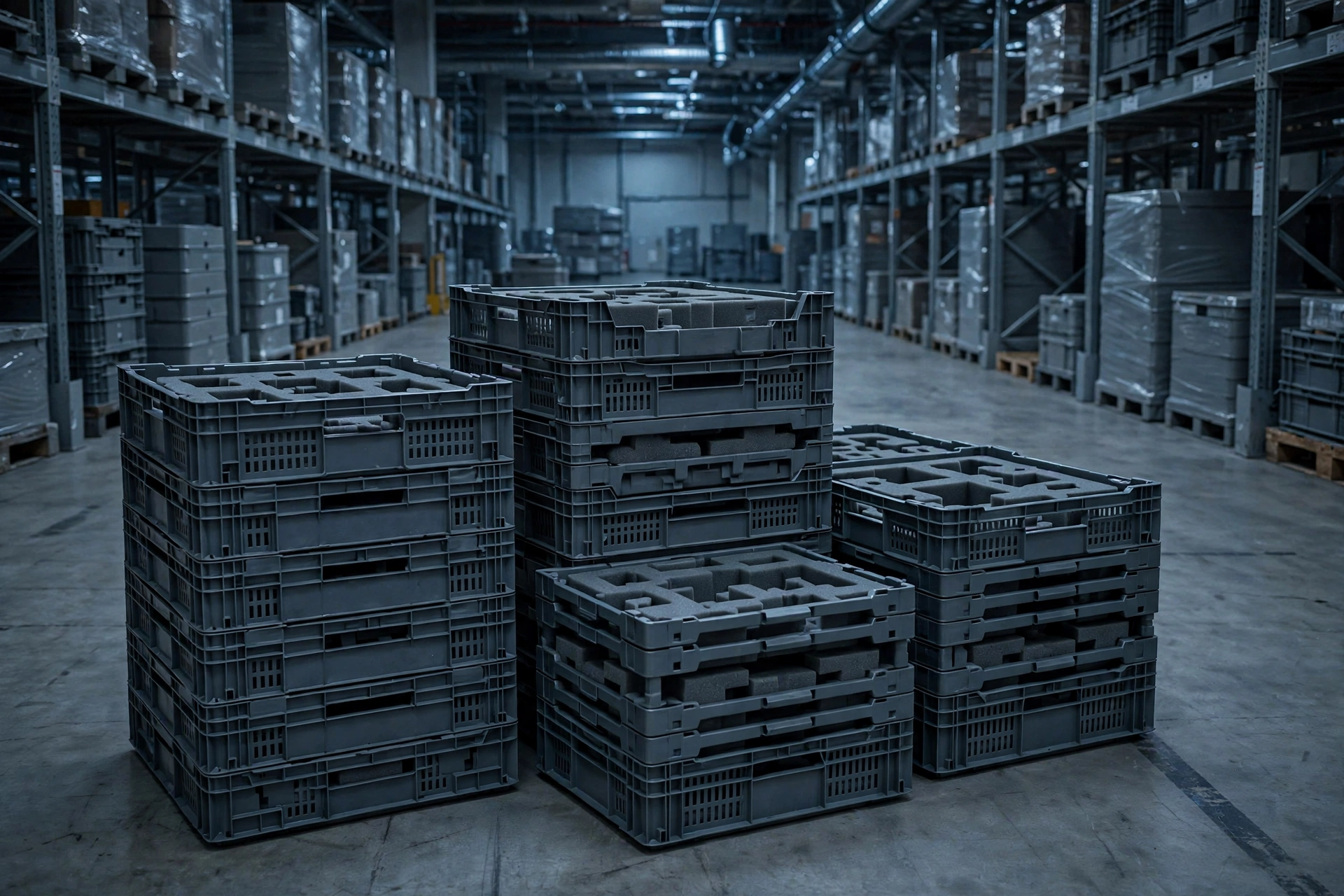 Concept visualisation
Reusable trays & totes
Thermoformed or fabricated trays with part-specific nests, designed to stack loaded and nest or stack efficiently when empty for the return leg.
Dunnage sets
EVA, PE foam or textile dunnage that drops into your existing racks, totes or stillages — protection upgraded without replacing the container fleet.
Returnable case systems
Fitted protective cases assigned to a loop — service exchanges, calibration rotation, demo fleets — with identity and contents labelling built in.
Trip life is a design input
Defined trip life
Materials and wall sections are chosen against your expected trip count and handling, so the unit cost per trip is predictable.
Return-ratio efficiency
Nesting and stacking ratios are considered at design stage — an efficient empty return leg is where loops save freight.
Wash & wear tolerance
Closed-cell materials and sealed surfaces that tolerate wash-down and resist absorbing oils and moisture in plant environments.
Identification
Engraved or printed part numbers, loop routing and asset IDs — plus colour coding per part or per site.
A quick loop check
Returnable packaging usually makes economic sense when the same parts move between the same two points at least weekly, the loop is under the operator's control, and the parts are valuable or finish-sensitive enough that damage costs more than the packaging. If your route is one-way or uncontrolled, a well-engineered single-trip solution is often the honest answer — tell us the route and we will say which side of the line it falls on.
| Inputs we need | Part drawings/dimensions, units per shipment, trips per month, route points, current packaging and its cost/damage history |
|---|---|
| Systems | Thermoformed trays, fabricated foam/textile dunnage, returnable fitted cases, hybrid tray + carton programmes |
| Output | System proposal with trip-life basis, return-ratio estimate and per-trip cost comparison against your current packaging |
Frequently asked questions
When does returnable packaging pay back?
Typically when the same parts move between the same points at least weekly on a controlled loop, and the parts are valuable or finish-sensitive. We model the per-trip cost against your current packaging in the proposal, so the decision is based on numbers, not preference.
What returnable systems can you build?
Thermoformed trays and totes, fabricated foam and textile dunnage sets, returnable fitted case systems, and hybrid tray-and-carton programmes — specified against your loop, units per shipment and handling.
How is trip life defined?
Trip life is a design input: materials and wall sections are chosen against your expected trip count and handling, so unit cost per trip is predictable. Nesting and stacking ratios are considered at design stage, because an efficient empty return leg is where loops save freight.
Can returnable units be identified and tracked?
Yes. Engraved or printed part numbers, loop routing and asset IDs can be applied, plus colour coding per part or per site. Closed-cell materials and sealed surfaces tolerate wash-down between trips.
What information do you need to propose a returnable system?
Part drawings or dimensions, units per shipment, trips per month, the route points, and your current packaging with its cost and damage history.
Describe your loop.
Route, frequency and the part itself — we will propose a system and show the per-trip maths behind it.