Custom EVA Foam Inserts
Foam interiors modelled from your part geometry — so every cavity grips, cushions and presents exactly as intended, whether the insert lives inside a case, a tray or a shipping carton.
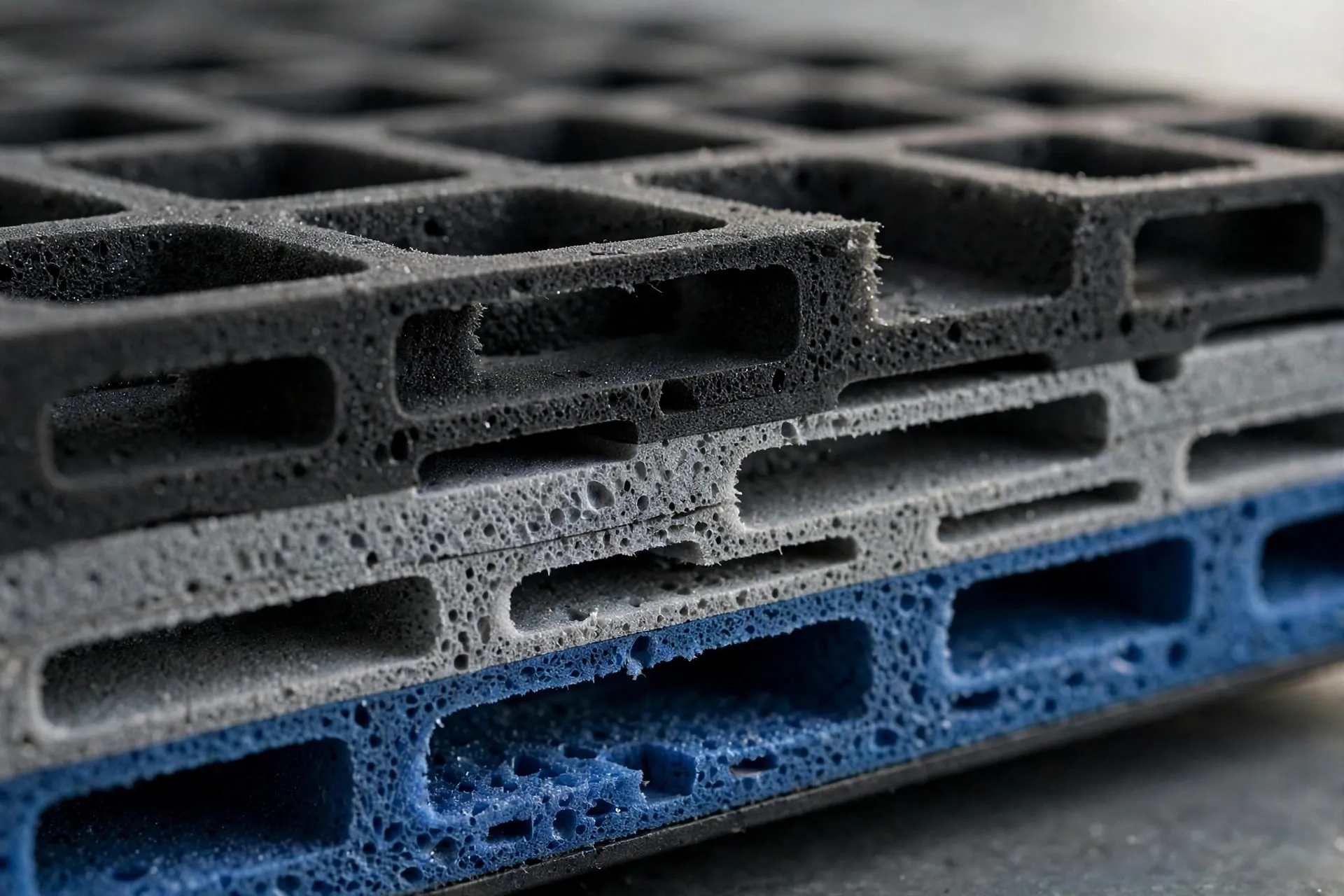
Engineered as a stack, not a slab
A single sheet of foam forces one density to do every job. We build inserts as layered constructions: a high-density base spreads point loads, a mid-density cradle absorbs shock, and a softer top layer protects finishes and retains parts during handling. Layers are laminated and machined as one insert, so cavities stay registered across the stack.
- CNC milling — sculpted 3D cavities and stepped depths for complex parts and prototypes.
- Die cutting — fast, economical profiles for flat parts and higher volumes.
- Waterjet cutting — clean edges on thick or multi-material stacks without tooling.
Configured to the application
Shadow boards & tool control
Contrasting top layer so a missing tool or component shows instantly — standard practice for service and assembly kits.
ESD-safe grades
Conductive and static-dissipative EVA options for circuit boards, sensors and electronic assemblies.
Engraved labelling
Part numbers, cavity names, orientation arrows and logos cut directly into the foam — no labels to peel off.
Finger pulls & access details
Scallops, ramps and relief cuts so parts lift out with gloves on, without prising at fragile edges.
Typical specification ranges
| Material | EVA foam (closed-cell), cross-linked PE foam options for specific chemical or temperature needs |
|---|---|
| Hardness range | Approx. 38°–75° Shore C, selected per cavity load and fragility |
| Construction | Single-density or laminated multi-density stacks; full-depth or stepped cavities |
| Conversion | CNC milling, steel-rule die cutting, waterjet cutting; skiving and lamination |
| Colours | Black and grey standard; dual-colour shadow-board combinations; other colours on request |
| Input required | STEP/IGES/DXF/PDF drawing, or the physical part for measurement |
| Quantities | Single prototypes through to repeat production runs |
Ranges are guidance for quotation. Final material and hardness are confirmed in the engineering proposal for your part, weight and transport route.
Frequently asked questions
What files do I need to send for a foam insert quotation?
STEP or IGES files of the part are ideal; DXF or PDF drawings also work. If you have no CAD, clear photos with key dimensions — or the physical part itself for measurement — are acceptable starting points.
How are foam density and hardness selected?
From the part's weight, fragility and contact area. Working hardness is approximately 38°–75° Shore C, and multi-density stacks let each layer do a different job — load spreading, cushioning and surface retention. The final material and hardness are confirmed in the engineering proposal.
Can I start with a single prototype?
Yes. Prototyping is a standard step in our process: a first article is produced on production processes, fit-checked and approved before any production run is released. Quantities run from single prototypes through to repeat production runs.
Are ESD-safe grades and colour coding available?
Yes. ESD-safe foam grades are available for electronics handling, dual-colour shadow-board combinations support tool control, and engraved labelling, finger pulls and access details can be built into the insert.
How does a foam insert project run, and how fast is a quotation?
Every project runs through our six-step process — brief and drawings, engineering proposal, prototype, approval, production, then QC and dispatch. For drawing-based RFQs, the engineering proposal and itemised quotation are prepared after an engineering review of the drawings.
Send the part. We will design the insert.
Email us your CAD or drawing — contact us by email first so we can agree how to share files securely — or tell us the part dimensions and weight and we will advise what we need.